


Particle Board
Jiangsu Dilun International Trading Company is a woodworking company founded in Xuzhou in 2011 and moved to Nanjing in 2019. We specialize in exporting plywood panels, kitchen cabinets & bathroom vanities, and furniture hardware. Since 2011, our products have been popular in the North American and European markets.
Our fully-owned factories are located in the beautiful city of Jiangsu in China. The production facility covers an area of more than 10,000 square meters and we employ over 200 employees. We have the latest advanced production equipment, which enables us to produce high-quality products at competitive prices.
At Jiangsu Dilun, we are committed to providing our customers with the highest quality wooden furniture and wood-based panel products. We strive to offer the best products at the most competitive prices. Our experienced staff is dedicated to providing our customers with the best possible service and value.
Professional team
Jiangsu Dilun International Trading Company is a woodworking company. We specialize in exporting plywood panels, kitchen cabinets & bathroom vanities, and furniture hardware.
Quality control
Jiangsu Dilun International Trading Company is committed to quality and excellence. The company follows a stringent quality control system to ensure all products meet the highest standards.
Advanced equipment
We have the latest advanced production equipment, which enables us to produce high-quality products at competitive prices.
Custom service
We also specialize in custom-made furniture and panel products, allowing our customers to design the furniture of their dreams. Our team of experienced designers and craftsmen is always available to help you create the perfect piece for your home or office.
-
![12mm Plain Chipboard]() Add to Inquiry
Add to Inquiry -
![Raw Particle Board 18mm]() Add to Inquiry
Add to Inquiry -
![18mm Plain Particle Board]() Add to Inquiry
Add to Inquiry
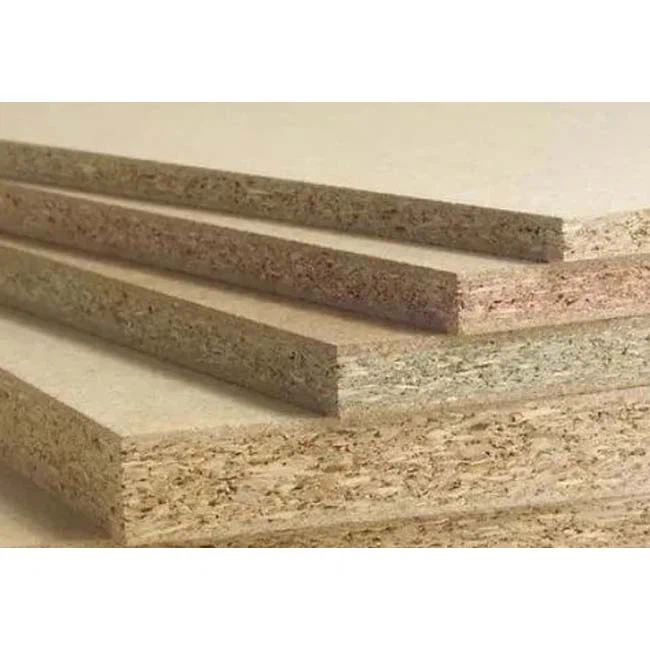


Particle board, also known as particleboard or chipboard, is an engineered wood product, belonging to the wood-based panels, manufactured from wood chips and a synthetic, mostly formaldehyde based resin or other suitable binder, which is pressed under a hot press, batch- or continuous- type, and produced. Particle board is often confused with oriented strand board (OSB, also known as flakeboard, or waferboard), a different type of fiberboard that uses machined wood flakes and offers more strength.
Benefits of Particle Board
Affordability
They are more cost-effective compared to solid wood or plywood, making them an excellent choice for budget-conscious projects.
Versatility
They can be used in various applications, including furniture, cabinetry, flooring, and wall paneling. They can be easily cut, shaped, and drilled to meet specific design requirements.
Sustainability
These laminates are an eco-friendly alternative to solid wood, as they are made from recycled wood waste. Additionally, responsible manufacturers ensure sustainable sourcing practices and minimize waste during production.
Stability
They have excellent dimensional stability, meaning they are less prone to warping or shrinking due to changes in humidity or temperature. This makes them suitable for areas with high moisture levels, such as kitchens and bathrooms.
Easy installation
Particle laminated boards are lightweight and easy to handle, making them convenient for DIY projects. They can be easily installed using screws, nails, or adhesives.
Lightweight
They are lighter than solid wood, making them easier to handle and install.
Affordability
They are more cost-effective compared to solid wood or plywood, making them an excellent choice for budget-conscious projects.
Versatility
They can be used in various applications, including furniture, cabinetry, flooring, and wall paneling. They can be easily cut, shaped, and drilled to meet specific design requirements.
Types of Particle Board
Single-layer particle board:
Single-layer particle board consists of wood particles of the same sizes which are pressed together. It is a flat and dense board that can be veneered or plastic laminated but not painted. This is a water-resistant type of particle board but is not waterproof. Single-layer particle boards are suitable for interior applications.
Three-layer particle board:
Three-layer particle board consists of a layer of large wood particles sandwiched between two layers made of very small and highly dense wood particles. The amount of resin in the outer layer is more than in the inner layer. The smooth surface of a three-layer particle board is ideal for painting.
Graded-density particle board:
Graded-density particle board consists of a layer of coarse wood particles which is sandwiched between two layers made of fine wood particles. This type of particle board is used to make cabinets and wooden furniture.
Melamine particle board:
Melamine particle board is made by fixing a decor paper infused with melamine on the surface of the particleboard under high heat and pressure. The wood particles in a melamine particle board are bonded using melamine-urea formaldehyde resin and wax emulsion. This makes it water-resistant. Melamine particle board resists scratches. It comes in a plethora of colors and textures. Applications of melamine particle board include wall paneling, furniture, wall cladding, wardrobes, and modular kitchens.
Cement-bonded particle board:
Cement-bonded particle board has magnesium-based cement or Portland cement as the bonding agent. Cement content is 60% while wooden particles such as wooden shavings, sawdust, and wood chips make up 20% of the composition. The remaining 20% is water. Due to the presence of cement, this type of particle board is resistant to moisture, fire, termites, and rot. High moisture resistance makes them suitable for constructing false ceilings, walls, and permanent coverings for concrete floors and walls for buildings located in areas with high humidity. They are also used for making fire-resistant furniture products.
Veneered particle board:
A veneered particle board means that it has a thin slice of wood called veneer attached to its surface. The veneered particle board appears like a natural wooden board. Furthermore, a veneered particle board is also more resistant to warping as compared to a conventional particle board.
Laminated particle board:
When a thin laminate sheet is attached to the surface of a plain particle board, it becomes a laminated particle board. A laminate sheet not only improves the aesthetics of the particle board but also increases its durability.
Uses of particle board in flooring:
Particle board is used as a flooring material in temporary structures where there is less application of loads. Also it is widely used as covering for hardwood floors, as hardwood boards have low resistance to scratches to protect them. Wood veneer particle board or laminated particle board is used in flooring where finished aesthetic look is desired.
Uses of particle board in flooring underlayment:
Particle board is extensively used as flooring underlayment or as a base for parquet flooring, wood flooring, or for carpets. For this purpose, the particle boards are treated with special chemicals and resins to make them waterproof or termite proof.
Uses of particle board in partitioning or wall paneling:
Particle boards are used in wall partitions, as they are non-load bearing members in the structure. For cost-effective options, particle boards can be used as they have thermal and sound insulation properties. Laminated particle boards are extensively used in wall panels as they give finished walls. You can select from a variety of design in laminated particle boards for wall panels.
Uses of particle board in false ceilings:
Laminated particle boards and cement particle boards are widely used in false ceilings. Due to their thermal insulation properties they are extensively used in false ceilings for centrally air-conditioned rooms. Particle boards are extensively used as ceiling tiles for auditoriums, computer centers, cinema halls and theaters and in as display boards in commercial establishments. In building construction it is used in false ceiling and paneling due to its thermo-acoustic insulation properties.
Uses of particle board in core material for doors:
Particle boards are also used as a core material in solid core doors as well as in flush doors. Particle core is the most commonly used in manufacturing doors, as it provides flat and smooth surface for bonding with the door skin. It also has good screw-holding capacity for fixing hinges, unlike medium density fibreboard.
Uses of particle board in furniture:
There are numerous uses of particle board in furniture industry. Particle boards are extensively used in residential as well as office furniture. Wood veneer particle board are gaining popularity as they are durable and perform better in moist environment as compared to plain particle board. So they are used in kitchen areas and bathrooms in the form of modular kitchen cabinets, storage units, countertops, table tops, wardrobes and dressing units. Plain particle boards are useful in interior areas like bedrooms which have beds, wardrobes, storage units, etc. It is also used in making shoe racks, computer tables, book shelves, television cabinets, etc.
Uses of particle board in commercial industry:
On commercial scale, particle boards are used in television, speaker boxes, sewing machine tops, display boards, automobiles’ parts and in other products which requires furnished surfaces. Wood veneer particle boards are very extensively used in this industry.
Process of Particle Board
Raw material preparation:
The first step for particle board production, is the preparation of raw materials. Wood chips or shavings be produced by wood chipper, to peeling and crushing wood bark into small chips.
Particle sizing and blending:
Once the raw materials are dried, they are subjected to a sizing process. The wood strands are sorted into different sizes, ranging from fine to coarse. These particles are then blended together in specific proportions, depending on the desired density and strength of the final particle board.
Resin application:
The blended wood particles /wood strands are transferred to a mixing chamber, where a resin binder is added. The resin, typically a urea-formaldehyde or melamine-urea-formaldehyde mixture, acts as an adhesive that binds the wood particles together. The resin is carefully applied to ensure even distribution, enhancing the overall strength and durability of the particle board.
Mat formation:
The resin-coated wood strands are spread onto a continuously moving conveyor belt, forming a thick mat. This mat is carefully monitored to ensure uniformity in thickness and distribution of particles. Special attention is given to achieving the desired density and surface smoothness of the particle board.
Hot pressing:
The mat of resin-coated wood particles is then transferred to a hydraulic multiple hot press. The press applies high pressure and temperature to the mat, activating the resin adhesive and facilitating the bonding process. The duration of pressing varies depending on the desired thickness and density of the particle board.
Cooling and trimming:
After the hot pressing stage, the particle board undergoes a cooling process to stabilize its structure and enhance its dimensional stability. Once cooled, the board is trimmed to achieve precise dimensions and smooth edges. Any surface imperfections or irregularities are carefully removed during this stage.
Finishing and quality control:
The final step in particle board production involves finishing and quality control. The particle board is sanded to achieve a smooth and uniform surface. It may also undergo additional treatments, such as the application of a protective coating or decorative veneer. Quality control measures are implemented to ensure that the finished particle board meets industry standards and customer requirements.
How to Maintain Particle Board


Avoid excess moisture:
Though particle board is meant to be moisture-resistant, it expands or warps when it absorbs too much water or any liquid material. To keep this from happening, wipe spills away using a damp cloth. Use tea coasters or mats to prevent placing hot things, such as cups, on it.
Protect from direct sunlight:
Agglomerate may turn pale or fade due to long exposure to direct sunlight. Place agglomerate furniture out of direct sunlight or cover it with curtains or blinds. Additionally, consider applying UV protection sprays on exposed surfaces.
Clean regularly:
General dusting and cleaning are necessary to keep the particle board looking nice. A soft cloth, microfiber, or dusting tool will gently remove dust or debris. In addition, lightly dampen the cloth with water or a mild household cleaner, avoiding excess moisture that may seep into the board.
Avoid harsh cleaners:
Harsh chemicals, abrasive cleaners, or solvents may damage the finish of particle board. Avoid harsh cleaners; instead, opt for non-abrasive, mild cleaners. Test a cleaner on a small, inconspicuous area before applying it to the entire surface to ensure that it does not cause any adverse effects.
Apply protective measures:
The surface of particle board is thus protected by placing placemats, tablecloths, or glass tops to protect from scratching, staining, and denting. These preventive measures can go a long way in lengthening the lifespan of your particle board furniture.
Fill small damage:
If you find minor scratches or chips on the particle board, you can fix it with a matching color marker or wood filler. Apply these products gingerly and follow the manufacturer's instructions for the best results possible.
Handle with care:
Wood is always stronger than chipboard would ever be; therefore one needs to be very careful while handling it. As a result, do not slide or drag anything heavy on it if you do not want such damages as breakages to occur. When it comes to moving heavy things from one place to another, you should either lift them cautiously or use sliders that are meant for furniture.
Product quality and standards:
Material composition: Look for suppliers offering particle boards made from high-quality wood and adhering to industry standards like CARB (California Air Resources Board) Phase 2 for formaldehyde emissions.
Board density and strength: Particle boards come in varying densities. Choose a supplier that offers options to suit your project’s specific needs – whether it requires high load-bearing capacity or lightweight options.
Surface finish: Consider the aesthetics of your project. Opt for suppliers offering particle boards with pre-finished surfaces like laminates or veneers if desired.
Product variety and customization:
Range of board sizes and thicknesses: Ensure the supplier offers particle boards in various sizes and thicknesses to accommodate your project’s requirements.
Customization options: Some suppliers allow customization of board sizes, edge banding, and pre-drilled holes. This can save time and enhance project efficiency.
Pricing and payment terms:
Competitive pricing: Compare prices from different suppliers while ensuring quality isn’t compromised.
Payment terms: Negotiate favorable payment terms that align with your cash flow.
Supplier reputation and reliability:
Industry experience: Choose a supplier with a proven track record and a strong reputation for delivering high-quality particle boards consistently.
Customer service: Look for a supplier that prioritizes customer service and offers prompt responses to inquiries and concerns.
On-time delivery: Reliable delivery schedules are crucial for project timelines. Choose a supplier with a good record of on-time deliveries.
Sustainability practices:
Sustainable sourcing: Consider suppliers committed to using recycled wood or wood from sustainably managed forests. This ensures responsible environmental practices.
FAQ
We're well-known as one of the leading particle board suppliers in China. Please rest assured to wholesale cheap particle board made in China here from our factory. All customized products are with high quality and competitive price. Contact us for more details.
large bathroom vanity, modern shaker kitchen cabinets, 48 Inch Bathroom Vanity with Sink