


Single Sink Vanity
Single sink vanities are the most common choice for small bathrooms or guest bathrooms. They are compact, versatile, and available in a wide range of designs. A single sink vanity typically includes one sink and offers a decent amount of counter space for toiletries.
Advantages of Single Sink Vanity
Easy to install
This is probably the most obvious advantage. Having one sink means it is much easy to install than a double sink vanity. You only have one sink and one faucet to install. Not to mention the price of installation will be cheaper with only one sink to install.
Best for small bathrooms
Having only one sink means the cabinetry can be made a lot smaller. If you are really limited on area, you can easily find one that can fit.
Storage space
This can differ in how the specific vanity was made but you can generally fit an extra drawer or two into the vanity. If you have a vanity with a big width and only one sink, you can probably fit an extra drawer on it.
More counter space
This is similar to our point of having more storage area. Having only a sink on a big width vanity gives you a tremendous more amount of countertop area. This lets you put more stuff including hairdryers, napkins, and other bathroom essentials.
-
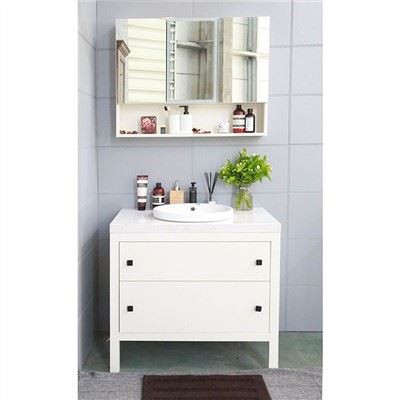
![24 inch Bathroom Vanity with Sink]()
24 inch Bathroom Vanity with Sink
Add to Inquiry -
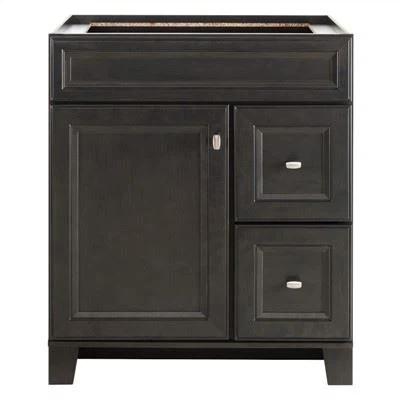
![30 inch gray bathroom vanity]() Add to Inquiry
Add to Inquiry -
![36 inch gray bathroom vanity]() Add to Inquiry
Add to Inquiry -
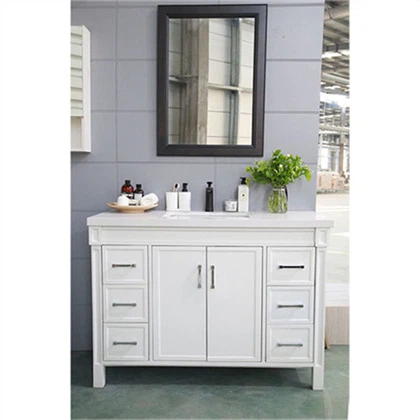
![48 Inch White Bathroom Vanity with Top]()
48 Inch White Bathroom Vanity with Top
Add to Inquiry -
![48 inch bathroom vanity with sink]()
48 inch bathroom vanity with sink
Add to Inquiry -
![48 inch white bathroom vanity]() Add to Inquiry
Add to Inquiry -
![48 inch white vanity]() Add to Inquiry
Add to Inquiry -
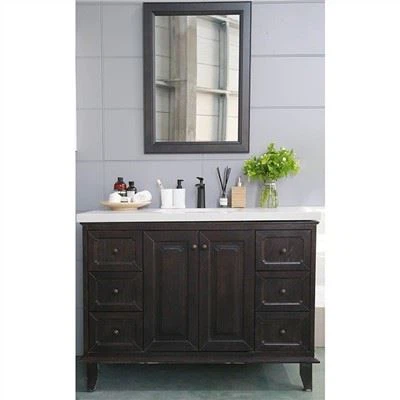
![48 Inch Brown Bathroom Vanity]() Add to Inquiry
Add to Inquiry -
![48 inch navy blue bathroom vanity]()
48 inch navy blue bathroom vanity
Add to Inquiry -
![48 inch gray bathroom vanity]() Add to Inquiry
Add to Inquiry -
![60 Inch Gray Bathroom Vanity]() Add to Inquiry
Add to Inquiry



Our Factory
Jiangsu Dilun International Trading Company is a woodworking company founded in Xuzhou in 2011 and moved to Nanjing in 2019. We specialize in exporting plywood panels, kitchen cabinets & bathroom vanities, and furniture hardware.
Rich Experience
We strive to offer the best products at the most competitive prices. Our experienced staff is dedicated to providing our customers with the best possible service and value.
Our Product
We are proud to offer a wide range of products, including kitchen cabinets, bathroom vanities, wooden crafts, and plywood. We also specialize in custom-made furniture and panel products, allowing our customers to design the furniture of their dreams. Our team of experienced designers and craftsmen is always available to help you create the perfect piece for your home or office.
Our Service
We take pride in our commitment to quality, value, and customer service. Our goal is to provide our customers with the best experience possible and to ensure that they are completely satisfied with their purchases. We strive to provide our customers with the highest quality products while offering competitive prices.
Design Styles of Bathroom Vanities
Console Vanities
Console vanities have a sophisticated yet straightforward style ideal for bathrooms with a more open design. With its simple shape, a console vanity offers just enough countertop and counter storage space without having a bulky cabinet in the bathroom space.
Corner Vanities
Corner vanities offer a smart solution for incorporating a vanity into a small bathroom or powder room design. Besides offering you a storage cabinet for bathroom essentials, corner vanities also maximize space that would ordinarily go to waste in bathrooms.
Freestanding Vanities
Freestanding vanities represent the most traditional of the styles of bathroom vanities available. As their name suggests, freestanding vanities are stand-alone units that sit on the bathroom floor. Freestanding vanities are attached to the wall with mounting screws to provide added stability. These vanities also incorporate a more refined look to a bathroom space with their furniture-like design.
Wall-Mounted Vanities
Often referred to as floating vanities, wall-mounted vanities are attached directly to the wall. They are not supported by legs or cabinetry that rests on the floor. If you’re concerned about limited floor space in your bathroom or if you want to create a bathroom design with clean lines, then wall-mounted vanities can create the aesthetic you want. You’ll often find wall-mounted vanities in contemporary bathroom designs that emphasize an open floor plan.
What Is the Most Popular Bathroom Vanity Size
The most popular size for a bathroom vanity depends on the size of the bathroom and the needs of the homeowner. However, a standard size for a single-sink bathroom vanity is between 600 and 900 millimetres wide, while a double-sink vanity can range from 1200 to 1500 millimetres wide.
In small bathrooms, a 600mm vanity is a popular choice as it provides enough counter space and storage without taking up too much room. For larger bathrooms, a double-sink vanity can be a practical and stylish choice, allowing for more space for two people to use the bathroom at the same time.
It's important to measure the space in your bathroom and choose a vanity size that fits comfortably and allows for adequate circulation. A vanity that is too big can make the bathroom feel cramped and uncomfortable, while one that is too small can be impractical and limit storage and counter space. Consider your personal needs and the design of your bathroom when choosing the size of your vanity.
Understand the Manufacturing Process of Bathroom Cabinets
Manufacturing materials of bathroom cabinets
The manufacturing material of bathroom cabinets is a key factor in determining their quality and durability. The common bathroom cabinet materials on the market currently include solid wood, pvc, artificial stone, etc. Solid wood is high-grade and durable, suitable for users who pursue quality; pvc material has excellent waterproof performance and is an ideal choice for modern bathrooms; while artificial stone emphasizes beauty and durability.
Main steps of the manufacturing process
1. Material cutting and forming
According to the design drawings and specifications, the raw materials are precisely cut by professional cutting equipment to ensure the accuracy of the size. In addition, advanced molding machines are used to perform preliminary molding of the materials, which determines the basic framework of the bathroom cabinet.
2. Grinding and surface treatment
The cut and shaped materials need to go through a grinding process to remove burrs and surface unevenness. Surface treatment includes polishing, painting and other steps to make the bathroom cabinet surface smooth, beautiful, waterproof and moisture-proof.
3. Assembly and fixing
Assemble each molded part according to the design requirements to ensure that each node is tightly combined to avoid loosening problems in future use. Common fixing methods include mortise and tenon structure, screw fixing, etc.
4. Inspection and packaging
The final step is a rigorous quality inspection to ensure that each bathroom cabinet meets factory standards in terms of appearance and internal quality. Bathroom cabinets that pass the inspection will be packaged, usually with protective measures to prevent damage during transportation.
Functional design of bathroom cabinet
Modern bathroom cabinets should not only meet the basic storage function, but also focus on design diversity and practicality. For example, embedded design and mirror cabinet design are popular functional designs that can provide more convenience in limited bathroom space.
How to Replace a Bathroom Vanity and Sink


Follow the steps below to remove a bathroom vanity and install a new one. Choosing a new bathroom vanity starts with an important first step, measuring your existing vanity. Bathroom vanities come in standard sizes, so manage your own expectations by sorting the models by size before you get too attached to a certain style of vanity.
Choose Your New Bathroom Vanity and Sink
If you haven't selected a new bathroom vanity yet, we created a shopping guide to show how a small vanity can make a big impact in a bathroom refresh. Consider a bathroom vanity set or shop collections of vanities plus a matching mirror, lights and faucets.
Remove the Existing Vanity and Install the New One
Step 1: Disconnect the Bathroom Sink
Start by turning off the water valves to the existing bathroom sink and opening the faucet to release any remaining pressure. Under the sink, there's a drainpipe that goes into a curved section, called the P-trap. Place a towel or bucket under the P-trap to catch water that spills from the trap. Loosen the nut at the top of the P-trap and pull the trap down off the sink's drainpipe. You may need to remove the trap completely.
Step 2: Disconnect the Bathroom Sink's Water Lines
Disconnect the water lines from the valves. You'll need to catch some water when you disconnect the lines. Use a utility knife to cut the caulk or sealant that connects the sink's backsplash to the wall.
Step 3: Remove the Bathroom Vanity and Repair the Wall
Remove the screws that hold the bathroom vanity to the wall and pull it out. If you need to repair drywall or repaint any sections of the wall that were damaged when you removed the vanity, this is the time to pick up a putty knife or paint brush and touch up the wall.
Step 4: Measure and Mark the Wall for the New Vanity
Mark out the new position with the width and height of the new bathroom vanity. Use a stud finder to locate and mark the studs within this outline of the vanity. If your new bathroom vanity has a solid back, measure out the position of the pipes on the wall and translate those measurements to the back of the vanity. Cut pipe holes with the correct size hole saw.
Tip
Never used a stud finder before? Read about How to Find Wall Studs for help.
Step 5: Install the New Bathroom Vanity
- Slide your bathroom vanity cabinet into position, lining it up with the marks you made earlier. You can remove the doors from your new vanity to make installation easier, if needed. Check that it's level and use shims to adjust the height if necessary.
- Once the bathroom vanity is level, drill pilot holes into the nearest studs and attach with screws. If you don't have studs to drill into, you'll need wall anchors to secure the vanity. Use the correct anchor for your wall. You can find anchors that work for drywall, tile or plaster.
Step 6: Install the Vanity Top
- If the bathroom vanity doesn't come with an attached counter, you can secure t vanity top to the cabinet with a thin bead of caulk. If you removed the vanity doors, reinstall them now.
- Apply a bead of caulk along the edge where the backsplash meets the wall. Use a caulk finishing tool or a rubber-or nitrile-gloved finger dipped in water to push the caulk into the gap between the bathroom vanity and the wall.
Step 7: Install the New Bathroom Faucet and Connect the Plumbing
- Be sure to put down a rope of plumber's putty underneath the sink drain ring.
- Attach the P-trap to the new sink drain line. Apply plumber's tape in a clockwise direction before attaching the water valve lines. Attach and tighten your bathroom faucet connections and turn the water valves back on. Test your bathroom faucet and check all the connections for leaks.
- There's a lot to consider when shopping for a new bathroom faucet. From sink compatibility and valve type to handle style and finish, there are many factors that make a bathroom faucet the perfect fit.
|
Single Sink Vanity |
Double Sink Vanity |
|
|
Size |
More compact, fits smaller bathrooms |
Requires minimum 60" of wall space |
|
Plumbing |
Simpler with one sink |
More complex with two sinks |
|
Cost |
Lower material and installation cost |
Higher cost with two sinks |
|
Usage |
Best for single user |
Allows simultaneous use by two people |
|
Storage |
Less counter and cabinet storage |
Greater storage capacity |
|
Style |
Clean, minimalist look |
Luxurious, spa-like aesthetic |
Bathroom vanities are available in single and double-sink designs. A single vanity has one basin and faucet, while a double vanity couples two sinks side-by-side. The choice impacts your bathroom's workflow, storage, aesthetics, and budget.
Key Factors to Consider
Bathroom Size
Measure the total dimensions of your bathroom space and create a layout plan. More layout are here: Bathroom Design Ideas And Inspiration - Elegant Showers This will help visualise what will fit.
Experts recommend a minimum of 60 inches of clear wall space for a double vanity. Singles can fit into smaller 25-30-inch spaces.
Consider traffic flow around the vanity - door swings and passages to the shower/toilet. Leave 21-24 inches clearance from vanity for comfort.
A double vanity is only feasible if you have an adequately sized bathroom. Be realistic about available square footage.
Plumbing
Back-to-back plumbing with drains and hot/cold supply lines in the vanity centre is ideal for doubles. This minimises pipe rerouting.
If existing plumbing is off-centre, the costs and complexity of rerouting supply and drain lines for two sinks may be prohibitive.
Inspect the current placement of water supply valves, drain pipes, and shut-off valves before planning a layout.
Hire a professional plumber to evaluate your existing setup if you want to switch from single to double vanity.
Daily Use
For master baths, double vanities are highly useful for couples with conflicting morning routines. No waiting to use the sink!
In kids' or guest baths that see intermittent single usage, doubles provide less utility since people are not using them simultaneously often.
If you frequently have visitors staying over who need to share the bathroom, the dual sink access of a double vanity simplifies hosting.
Design Tastes
Those wanting a glamorous master bath look prefer dual sinks for the spa-like vibe.
Minimalists should weigh if the cleaner look of a single vanity better suits their aesthetic vision for the space.
Remember that double vanities require substantially more visual real estate - ensure they align with your desired style.
Maintain the plumbing elements of your vanities
The water from the various items on your vanity, such as faucets, the pipes, the handles, and other areas of the sink, may cause damage if it leaks onto too many different areas of your bathroom vanities. For example, you may not notice a leak underneath a sink until you start to see mold growing out from between the dresser doors. This leak will spread rapidly and cause severe damage to your vanity.
As a result, you need to take the time to perform simple maintenance steps on your plumbing elements. For example, you can fix leaky faucets to prevent damage. Typically, this step requires opening the tap and checking the o-ring. This important sealing element will keep your faucet from leaking but can get damaged over time. Replace it with a new one to prevent more leaks.
Beyond this step, you also need to regularly clean the end of your faucet spout to keep water flowing smoothly. Use a simple pipe cleaner to break apart dirt and other buildups to avoid problematic issues. You should also open up your sink trap and remove any debris that may have built up inside, such as various types of gunk, soap debris, toothpaste, and other items that may have washed down the drain unexpectedly.
Clean and repair countertops
The countertops of your bathroom vanitiesoften suffer from a variety of stains and buildups that can be problematic for their surface strength. For example, water may wear away the surface of your countertops and cause severe damage that may spread rapidly. Different situations trigger this issue, such as backsplash from when your sink runs and spilling items like toothpaste and soap onto the countertop.
Take the time to properly clean the surface to ensure it doesn't experience other types of damage. Wiping down the surface every time you use the vanity will ensure that it is protected from various types of damage. You should also make sure to clean the surface with an appropriate vanity cleaner to break apart stains and other problems that build up on the surface of your countertop.
Make sure to add sealant to areas that need it, such as around the edges of the vanity's sides and any other spots that need caulk. Apply new caulk to these spots to prevent water leakage and to keep the sides as secure as possible from wear and tear damage. Let the caulk dry for at least 20 minutes before adding another layer. Two layers of caulk should be more than enough to keep your countertops secure.
Frame maintenance and repairs
The frame of a vanity is the most crucial element for keeping your bathroom vanitiesstrong. Unfortunately, the large bulk of the structure is prone to various types of damage, particularly mold, breakdowns, cracks in the surface of the countertop, and various other problems that can threaten the integrity of your vanity and its overall structure.
Many of these problems can build on each other and cause more complications. For example, multiple cracks in a countertop may combine to make an even bigger crack. This significant break in the vanity frame may widen due to water and temperature-based damage to make repair or replacement of your vanity frame absolutely necessary.
Repairs often include spot-fixes like removing a cracked panel and replacing it with another. However, you may also need to remove water-damaged material, check for mold, and add filler to smaller cracks to keep them from growing.
FAQ
We're well-known as one of the leading single sink vanity suppliers in China. Please rest assured to wholesale cheap single sink vanity made in China here from our factory. All customized products are with high quality and competitive price. Contact us for more details.
bathroom vanity no sink, slim bathroom vanity, 48 Inch Brown Bathroom Vanity